Hindsight, as the saying goes, is 20/20. Decompressing within the sway of our porch swing which overlooks the Cape Fear River marsh, or smelling the salt and hearing the waves of the Atlantic crashing on the beach as I sit in my folding canvas chair, or even reminiscing at a stop light behind the riddle-me-this vanity tags and divisive bumper stickers, my mind can recall this life’s pathways rather easily: I was born there (Los Angeles), but then when I was five my parents moved our family to a different there (Atlanta). Or the day I was riding my bike down the speedy hill of our street and looked over to keep my eye on an approaching car at the upcoming intersection. I didn’t see the huge rock that sent me hurtling end over end across the unforgiving asphalt. The woman who lived in front of this mishap had a carved, wooden sign hanging on her chain link fence – “No solicitors or religious nuts!” Dad, a lifelong church-going boy, had a definite opinion about her even though we had never stopped to talk. But there she was, picking me up off the ground, making sure nothing was broken. She pushed my bike, handlebars askew, all the way to our house while I limped home with the cuts and scratches burning like fire. Turns out she was one of the nicest people on our entire block. Another old saying comes to mind about books and their covers.
Or, one of my favorite forks in the road, requesting – and permission granted – to be transferred from my stint on the landscape crew to work in the field hall kitchen my second year of college. Although learning how to backup a leaf/limb trailer with a Kubota tractor like nobody’s business during my first year was fun for a minute, the joy only lasted until the first frost of the season showed up and sent me down the streets of campus on that orange tractor with teeth chattering and cold wind shooting straight down the neck opening of my jacket. The kitchen, you see, had ovens, steamy dishwashers and heating systems connected to boilers all calling out like sirens. Little did I know at the time, the kitchen also employed a very cute, freshman fireball from Arkansas named Sandie who would soon catch my eye (er, stare). To this day she sleeps beside me and keeps me warm every night. Sometimes I refer to her by her alter-ego, the Human Heater.
But one of the most sweeping course changes I’ve ever experienced was set in motion by a casual fate to sign up for Technical Drawing – instead of Basic Woodworking – for a required elective course in my 11th grade tenure at Lakeshore High School. This decision, seemingly menial at the time, would place me en route to the tutelage of a straight-shooting drafting teacher who would alter this 15-year old, scrawny kid’s trajectory forever: the late, great Mr. (James) Henderson.
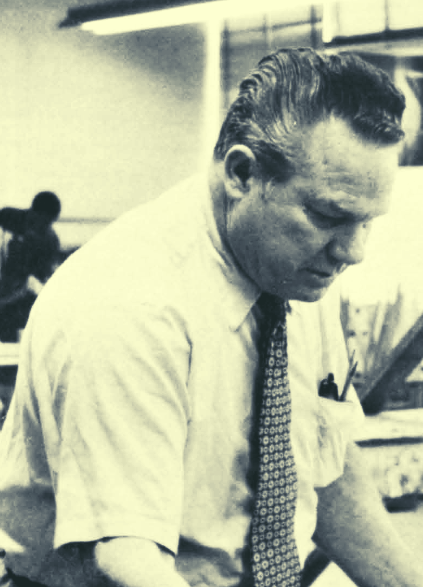
Mr. Henderson was short and stocky, his gray hair cut short on the sides and brushed back on top to reveal a large authoritative forehead, and he spoke in a commanding, and yet surprisingly respectful, tone to all of us knuckle headed punks who sat at our tilted drafting desks scattered around the classroom. Most days he wore a tie with a short-sleeved dress shirt. The pocket always had technical pencils and reading glasses clipped within. As well, he had the unique perspective of most vocational course instructors – no theoretical or philosophical mantras to impart, no equations or sentence deconstructing skills to hand over, but all sorts of wisdom to pass along about how the real-world job market worked. If we paid attention, we may just learn a few valuable skills which could serve us well in our imminent, inevitable roles as responsible, employed adults.
To start, we had no clue what a circle template or erasing shield was or how to use a t-square or drafting triangles. Thus our master began teaching us how to use these implements in a Mr. Miyagi-like exercise given to all students beginning the study of technical drawing – lettering. Nothing prepares your hands for drawing intricate mechanical components, floor plans or product details using your hands and your straight edges like “wax on, wax off, paint the fence” architectural lettering. In fact, this rite of passage is one of the shared bonds most folks in my cohort hold dear from their earliest memories of training.
To learn lettering, you have to throw out nearly everything you were taught about how to write the alphabet by your first grade teacher – sorry Ms. Ard. This method of script is founded in precision, order, and for that matter, the beauty of a perfectly straight line. You begin by using the t-square to sketch two faint, horizontal lines across the paper, which will act as guides for the height of the letters. Every single letter of each word is then drawn with straight edges, except for the curves of the few letters which have round components like B, R and S, or the ones which have angled lines like A, N and W. All vertical letter lines are drawn by placing a drafting triangle – usually a bright, translucent orange – on the t-square and dragging your pencil lead down the paper while it is pressed firmly against the triangle’s edge. For example, an N is constructed by drawing two vertical lines using your triangle and then connecting the two with a carefully placed diagonal. All horizontal lines, such as the legs in an E, L or Z, are drawn using the t-square. The trick is to use your non-drawing hand to push the square up against the left edge of the drawing board (opposite for South Paws) and holding it down firmly while your dominant hand drags the lead across the top edge of the plastic. It is a tedious, meticulous style to learn and a single line of text can take minutes to lay out. After working on this skill for a couple weeks, our muscle memory started to take over and our fingers, eyes and tools learned to work in unison, a sort of industrial-age rhythm. The final results were detail notes as precise in their execution as the objects being drawn. Mr. Henderson even showed us how each draftsperson may develop their own style where they drag the angled leg of an R below, or the right-hand vertical line of an N above, the guidelines. Even numbers could be stylized – my favorite always being an “8” drawn by placing two ellipses on top of each other, with the one on the bottom being slightly larger than the one on top, not unlike a snowman’s head and body.
Next on the syllabus, Mr. H (no, we did not call him that to his face) taught us how to draw an object in three views: top and two sides. These would all be laid out on the sheet so you could project lines from the top view to the side views. Once again, there was a system of how to accomplish this task. Even a round drum-like object seen from the top, looks like a rectangle from the side, given it’s thickness, for example. After weeks and hours of drawing three views of all sorts of objects, he was actually imparting the most valuable skill creative people use every single day – how to think in three dimensions. It’s something we architects take for granted. It is a sixth sense, and I’ve had so many clients sitting in front of me who are wizards in their line of business who do not possess this gift. They listen to you explain how a space works, but they stare with glazed eyes because they’ve never had to learn how to do this. And of course, that’s why they hire us in the first place. But here we were learning how to do this in a public school with limited resources, before we could even vote for the President – seeing every object in our surroundings with brand new eyes.
One day, Mr. Henderson brought into class a huge ream of drawing paper – 11×17 sherbet green card stock – and told us if we wanted to obtain extra credit, we could take sheets of this paper home along with our t-squares and our zipper pouch-stored drafting tools. If we could successfully find a straight-edged table there, and then work on extra drawing assignments after school, we could bring in these additional drawings to improve our grade.
Since my elementary school days, I’ve adored the experience of drawing. The pleasure of seeing anything with your own eyes, and then attempting to reproduce it by hand, a sharp pencil, and any paper you could find, is addictive. Of course as a teen, you’re drawing hot rods or comic book characters. But subject matter was not that important. Whatever insecurities I already had by that time were put aside for an hour or two. It was a meditative process – just you alone in your room with these small hand tools made from trees and lead, creating. So to offer “extra credit” for something I had already sewed to my identity was an easy sale for Mr. H. Challenge accepted!.
The only problem was finding a straight-edged surface with which to work from home. Our dinner table had curved edges, with a shaped, routed edge. Dad’s desk was off-limits too. But it just so happened my status as the oldest sibling earned me my own bedroom in our converted basement. Between this room and the stairs that took me up to the kitchen was the remainder of the basement used as an unfinished laundry/utility room. And right outside my bedroom door was a large chest freezer.
My parents were born in the mid 1940’s, only a few short years after the Great Depression. Instilled into their heads from an early age by their own parents was a need to save money, save food, save anything – just in case the economic world melted again. In the early 1980’s, similar to today where most Americans possess microwaves, front-loading clothes washers, refrigerators with ice makers, and air fryers, it seemed nearly all of my relatives had a chest freezer stocked with a month’s supply of bacon, chicken, pot roast, potatoes, blueberries, and a box of pop-sickles. They were simple, oversized boxes with their lids lying flat on the top, made with smooth, white sheet metal, concealed insulation, and a tiny freezer compressor underneath attached to a wall outlet with a single power chord – a near-perfect spec as well for a high school drafting board.
The chest freezer my parents owned was the absolute perfect height for standing and drawing. No, my made-up desk did not tilt for comfort, but at that age who cares about their backs? I found a good desk lamp to keep my paper brightly lit and I was set. Night after night, there I stood alone in the basement, my record collection blaring from within my bedroom on the other side of the wall, drawing all of these objects – most of which appeared to be some sort of mechanical equipment: gears, steel brackets with drilled holes, or who-knows-what from some 1950’s-era fabrication process. Over the course of this class, I turned in a stack of drawings at the rate of one or two per day. Mr Henderson just quietly accepted them and would say, “Good job!”
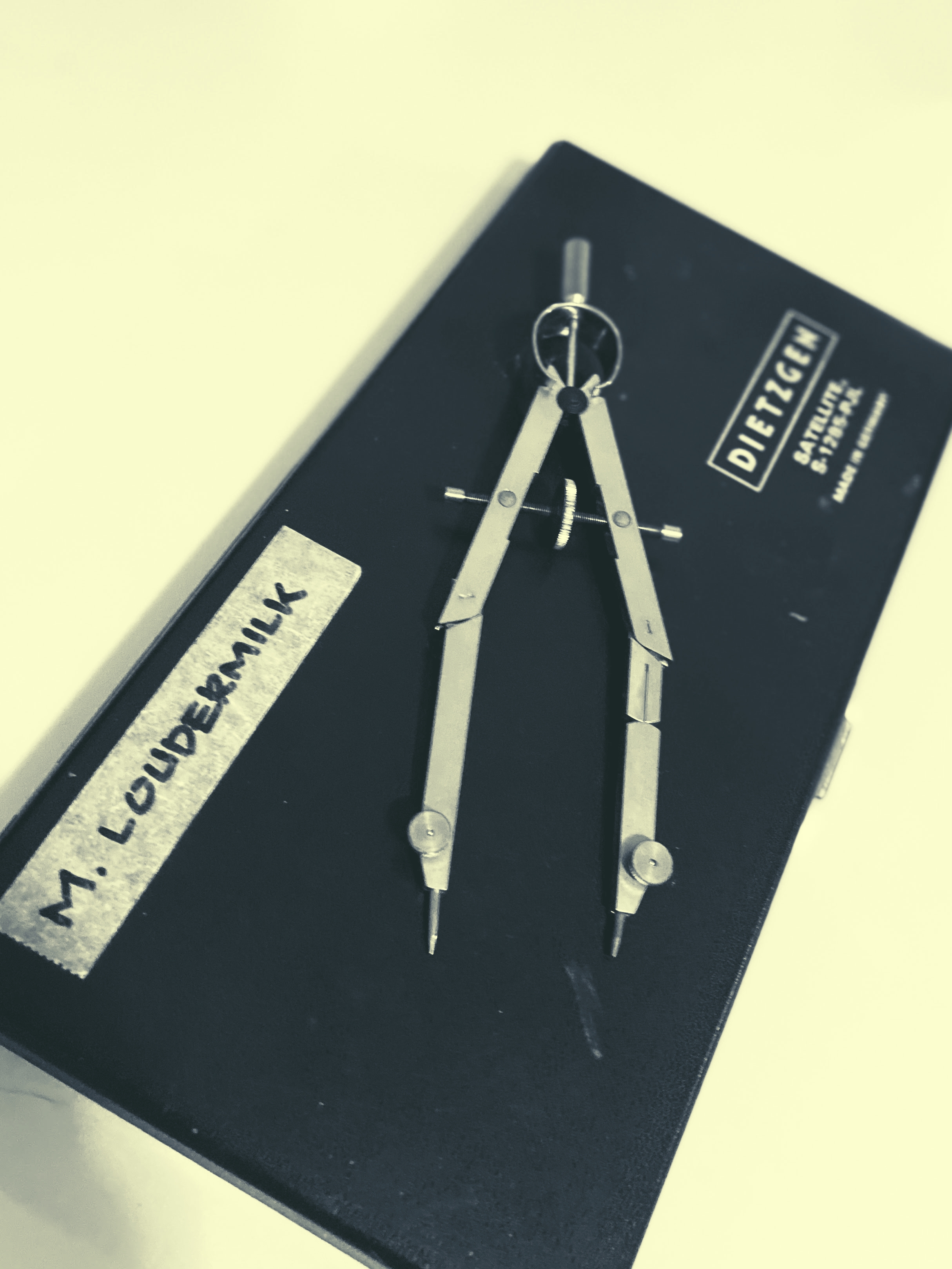
On our final day of the quarter, Mr. Henderson stood to remind us of how much he enjoyed teaching us and how impressed he was with our progress as drafts-people. But for what happened next, I was not prepared. He called me up to the front of the room. In his hand was a thin, black box. He then told everyone that I had turned in so many additional drawings, I had earned the highest grade in the entire class. He then handed me the box, my prize for this achievement. On the top it had small, white letters which said, “DIETZGEN – MADE IN GERMANY.” It appeared to be some sort of drawing tool. He instructed me to open it. Inside was the most glorious compass set I had ever seen. Lying in what reminded me of blue jewelry fabric were precision-crafted, shiny, aluminum, circle-crafting implements. The set had attachments I didn’t yet understand, so Mr. H briefly told me what they were: one for drawing in ink and another which allowed one to construct radii of much larger sizes. The gears which adjusted the width of the compass legs operated like a watch with extremely fine increments. The legs also had knee-like bends half way down their length to allow the pencil lead to sit perpendicular to the page. Unlike our standard-issue, tax-funded tools, these felt exquisite in your hand.
I was dumbfounded by this presentation. But then Mr. H dropped a bomb on me. “These tools will serve you well in your profession.”
Profession? The room was tilting and my head was spinning! Before that precise moment, I had never seen myself becoming any sort of professional. No one in my family tree had even attended college, except my uncle Dennis who worked part time and took a class or two at a time studying math and computers. But he lived far away back in California. Dad had never finished high school, and was a truck driver. A hardworking one at that and we never went without food, shoes, or bicycles. My maternal Grandpa worked in a machine shop most of his life making tools and dies for production – a skilled laborer for certain. And my paternal Grandpa, whom I saw only a handful of times my entire life, was in building construction. The women in our family were all traditional housewives. So there was no expectation for me or my siblings to attend college and become a professional anything. But when Mr. Henderson spoke that single word to me, it was shocking, stunning, unforeseen. It cast a vision seed way on down in my soul, a prophecy to be fulfilled at all costs.
The next few years saw me trying to figure out what I wanted to be when I grew up. I was accepted to Georgia Tech, but engineering school seemed too scary at the time. Dad advised me to attend a liberal arts school for a couple years until I could figure it out. That seemed safe. My senior year at Lakeshore High, Mr. Henderson had retired, but he came back for a visit one day and I caught him in the hallway. He asked me if I had made a decision about college and I told him about my liberal arts scheme. “Damn it, no!” his finger jabbing my chest. “If you do that, you’ll never go to Tech!” Although I had seemed to disappoint my mentor, it was too late to change plans at this point.
Of course, the liberal arts school is where I met the Human Heater. We contrived a plan to marry and live on love while we both worked with associate degrees in nothing in particular. We test ran this plan for a short time, and I shuffled from job to job trying to find something meaningful and sustainable. But Mr. H’s voice was always in the back of my head – “…your profession.” Living in Memphis, near where my bride was raised, I finally enrolled at age 23 in a two-year architectural program at the local technical institute. I was working forty hours a week in an old Model A assembly plant on the banks of the Mississippi River, built and later abandoned by Ford decades prior, where we converted old Fotomat kiosks into FedEx package drop-off stations. But when the daily whistle (yes, it was real) blew at 5pm, I couldn’t wait to clock out and rush over to my full class load at night. These classes were giving me meaning and taking me back in the right direction.
One night after class, I asked my residential design instructor if the program in which I was enrolled would put me on course to becoming an architect. “No, it won’t” he said grimly. “To become a licensed architect you have to study design for five years at UT.” He was referring to the University of Tennessee’s School of Architecture in Knoxville, at the foothills of the Smoky Mountains at the other end of the state. Well, what was I waiting for? There it was…the door at the back of the wardrobe. Sandie and I discussed it intensely, and I soon made application and was subsequently accepted as a freshman to the class of ’94. In the fall of my 25th year, we headed to Knoxville in a tiny Honda Civic, her mom and dad following behind us in the U-Haul which carried our tiny cargo of furniture. I navigated UT as one of those “older” students, while the Heater worked full time to keep us fed. It was another five years of long nights crouched over a drafting table (a real one this time), but finally, at age 29, I graduated with a B. Arch degree, Magna Cum Laude.
Yes, Mr. H, you were right. I never went to Georgia Tech. But I did become a professional. I wish you were still around so I could show you my life now, one that you helped inspire. And even though now all of our designs are drawn using computers, I still have my Dietzgen set nearby on my desk, an inspirational connection to a time when I had no clue as to the potential lying deep within me. Every now and then I glance over toward it and send you an informal, yet ever so grateful salute.
 learning2breathe